Pro-Data Blog
How CyberNet AI migrated its Kubernetes cluster to the Pro-Data cloud and improved service quality
November 26, 2026



As a developer of voice AI robots for banks and telecom companies, CyberNet AI handles a high volume of calls, which is why it works with multiple providers and maintains local sites in every country where it operates. To improve service quality, the team migrated one of its production clusters from another provider to Pro-Data Managed Kubernetes: 40 worker nodes and hundreds of services. The result: a higher-performing cluster for the same cost.
Case summary
Client. CyberNet AI develops conversational AI voice bots for phone interactions with bank and telecom customers.
Challenge. Improve service quality by migrating the production cluster to a platform with Managed Kubernetes, Terraform support, and responsive tech support—all while avoiding vendor lock-in and ensuring data stays in-country.
Solution. Migrated the cluster from another provider to Managed Kubernetes in Pro-Data's Kazakhstan cloud, implemented Infrastructure as Code via a Terraform provider, and set up autoscaling based on request volume.
Results. The cluster handles higher loads, is fully managed via code, keeps customer data within the country, and incurred no increase in infrastructure costs.
About the client
CyberNet AI creates voice robots that talk to customers over the phone in real time. The company trains its own NLU models: it takes an open-source foundation and fine-tunes it using its own data to meet the specific scenarios of each client.
Its clients include telecom operators and banks in Kazakhstan. The robot reduces the cost per contact, stays on script, and allows for large databases to be called in a short time without expanding the call center.
CyberNet AI robots handle over 3.5 million minutes of conversation per month. The company operates in Kazakhstan, Uzbekistan, Kyrgyzstan, Egypt, Mexico, the USA, and Europe.
The challenge: high call volumes, multiple providers, and data residency
CyberNet AI’s revenue depends on calls: its robots conduct a high volume of conversations every day for banks and telecom operators. Behind this is a large-scale installation—hundreds of services, including non-standard AI workloads that require significant CPU and memory resources.
With such high volumes, the company cannot rely on a single provider or data center, so CyberNet AI’s infrastructure is built across several independent sites. One of its production clusters was running with another provider, and the team decided to migrate it to a platform with higher service quality: managed Kubernetes, infrastructure as code, and the capacity for rapid scaling to keep pace with the growth in call volume.
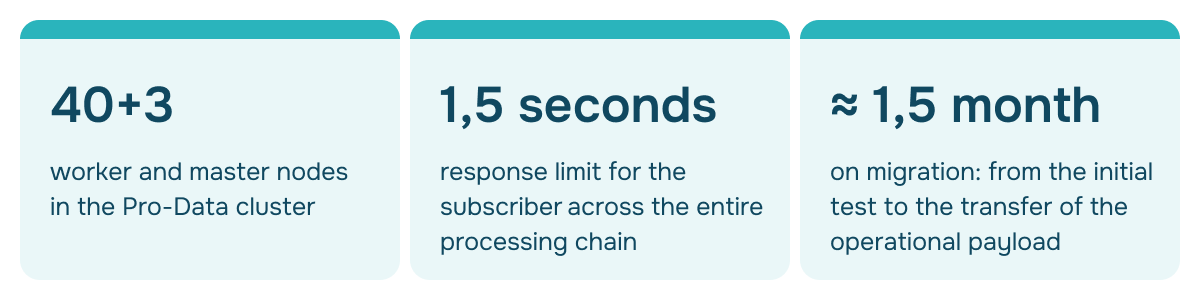
There is a second requirement: speed. For a conversation to sound natural, the entire response processing chain must reply to the caller in no more than 1.5 seconds. The cluster is responsible for part of this chain, and there is no room for slow infrastructure.
The third requirement is data sovereignty. CyberNet AI’s clients are banks and telecom operators, and their customer data must be stored and processed within the country. Therefore, the company maintains a local site in every country where it operates.
The team did not consider purchasing its own hardware: CyberNet AI has built its product in the cloud from the very beginning and does not want to spend resources on colocation, hardware, or its administration.
Why Pro-Data
CyberNet AI compared several providers based on five requirements:
Pro-Data met all five. An additional benefit is flexibility: the provider is ready to grow alongside the client’s business and offers local sites not only in Kazakhstan but also in Uzbekistan.

The solution
How the migration went
The cluster handles production traffic, so we migrated it in stages without rushing. The entire migration, including monitoring, took about a month and a half.
Result

What's next
CyberNet AI's plans for the coming year include launching a generative model and establishing a presence in Western markets.
Pro-Data, in turn, will continue to develop its cloud and AI infrastructure in Kazakhstan and Uzbekistan so that clients receive high-quality service, can quickly scale resources as their business grows, and keep their data within the country.